In-House Workflow Infrastructure: Why Every Company Builds the Same Thing
Efrain Sotelo Ferry · 19 Mar 2026
Every engineering company that runs simulations at scale ends up building the same thing: a job scheduler, a file management system, post-processing scripts, and a set of conventions that hold it all together. Not because this infrastructure is part of their competitive advantage — it is not — but because nothing else existed that understood simulation workflows well enough to be useful.
The result is an industry where hundreds of teams independently assemble the same plumbing, each spending months of engineering time on work that has nothing to do with aerodynamics, structural mechanics, or control systems.
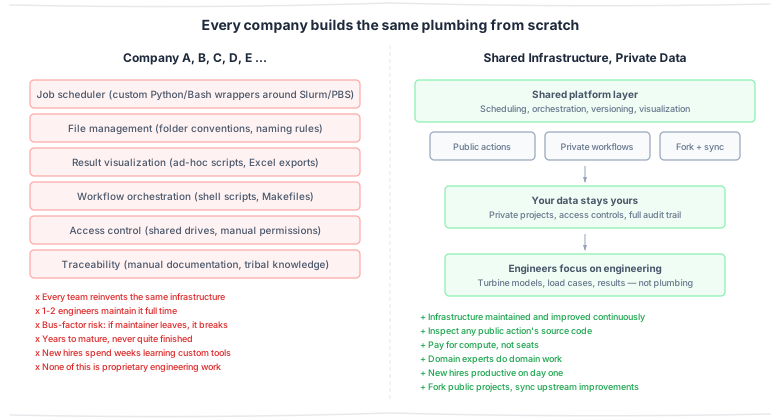
Again and Again
Walk into any company that runs engineering simulations at scale and you will find a remarkably similar set of homegrown tools. A job scheduler — maybe a Python wrapper around PBS, Slurm, or a cloud VM launcher. A folder convention for inputs and outputs that everyone sort of follows. A collection of post-processing scripts that one senior engineer wrote and nobody else fully understands. An Excel spreadsheet that maps Design Load Cases to simulation parameters.
Every company builds this infrastructure from scratch. Not because the infrastructure itself is proprietary — a job scheduler is a job scheduler — but because nobody offers a platform that fits the domain well enough to trust. So each team reinvents the wheel, spending months of engineering time on plumbing that has nothing to do with the actual engineering.
The cost is real. One or two full-time engineers maintaining internal tools. Months of onboarding time for new hires who must learn the custom system. And the ever-present bus-factor risk: when the toolchain maintainer leaves, institutional knowledge walks out the door with them.
The irony is that none of this work is secret. If you could compare the internal toolchains of ten different wind turbine OEMs, you would find the same patterns, the same pain points, the same workarounds. They are all solving the same problem in isolation.
How Other Engineering Fields Solved This
This problem is not unique to simulation. Other engineering fields faced the same tension between protecting proprietary work and sharing common infrastructure. They solved it by separating the toolchain from the intellectual property.
Software engineering is the clearest example. Millions of companies use GitHub — a shared platform — without exposing their proprietary code. Private repositories, access controls, and collaboration tools let them benefit from shared infrastructure (version control, CI/CD, code review) while keeping their IP completely private. Nobody builds their own Git hosting anymore. The competitive advantage is in the code, not in the system that stores it.
Hardware and electronics followed a similar path. Open-source EDA tools, shared component libraries, and standardized interfaces like USB or PCIe mean that companies compete on design, not on the toolchain. A chip designer at a startup uses the same layout tools as an engineer at a major semiconductor firm.
CFD and FEM are already partway there. OpenFOAM, FEniCS, Code_Aster — these open-source solvers are used by major corporations alongside commercial tools. The solver is shared; the geometry definitions, boundary conditions, material models, and domain expertise are the real IP. No company loses competitive advantage because another company also uses OpenFOAM.
DevOps infrastructure made this leap a decade ago. Kubernetes, Docker, and Terraform are open-source tools that companies trust with their most critical production systems. The orchestration layer is shared. The competitive advantage is in what you deploy, not in how you deploy it.
In every case, the pattern is the same: the infrastructure becomes shared, and competition moves up the stack to where domain expertise actually lives.
Shared Infrastructure, Private Data
The model that worked for software, for CFD, and for cloud infrastructure applies directly to simulation workflows: share the infrastructure layer, keep the data and domain knowledge private.
A platform like Pencilroads works this way. The workflow orchestration, job scheduling, file versioning, result visualization, and collaboration tools are shared infrastructure — maintained, improved, and operated by the platform. Your simulation inputs, outputs, workflow definitions, and domain logic stay in your private project. Other organizations cannot see your data, just as other companies cannot see your private GitHub repositories.
This separation directly addresses the reasons that pushed companies toward building everything from scratch:
- IP protection. Projects can be private. Access controls determine who sees what. Your proprietary blade geometry, controller parameters, and load case definitions never leave your private scope.
- Transparency. Public actions — the reusable building blocks of workflows — show their source code. You can inspect exactly what a converter action does before you use it. If you need to modify it, fork it and make your changes privately.
- Customization without maintenance burden. The fork model lets you take a public workflow template, customize it for your specific needs, and keep your modifications private. When the upstream project improves, you can sync those improvements into your fork without losing your customizations.
- Pay for compute, not headcount. You pay for compute when you run simulations, not for the number of people who can view results. The entire team — loads engineers, project managers, certification auditors — can access the platform.
What Is Actually Proprietary?
It is worth being precise about where IP lives in a simulation workflow. When a wind turbine OEM runs a loads analysis, the competitive advantage is not in the job scheduler or the file storage system. It is in:
- The turbine model parameters (blade geometry, tower properties, drivetrain configuration)
- The control strategy and tuning parameters
- The site-specific environmental conditions and load case matrix
- The interpretation of results and design decisions
- The post-processing methodologies developed over years of experience
None of these live in the orchestration layer. They live in your project files and in the heads of your engineers. A shared platform that handles the plumbing while you keep control of the domain content is not a compromise — it is a cleaner separation of concerns.
The Onboarding Argument
There is one more cost to in-house toolchains that rarely appears in budget discussions: onboarding time. When a new engineer joins a team that uses custom internal tools, they face weeks of learning how the in-house system works. Which folder goes where, how to launch jobs, how to find results from a previous campaign, which script to run for post-processing.
A maintained platform with consistent interfaces, documentation, and a standard workflow model reduces this to days. The new hire can focus on the domain — understanding the turbine model, learning the Design Load Case structure, interpreting fatigue results — instead of deciphering internal tooling conventions.
Stop Building Plumbing
The wind energy industry — and structural engineering more broadly — has some of the most capable engineers in the world spending their time writing job scheduler wrappers and debugging file path conventions. That is not where value is created.
The pattern from every other engineering field is clear: when infrastructure becomes shared, teams move faster, onboard people faster, and spend more time on the work that actually differentiates them. GitHub did not make software companies less competitive — it freed them to compete on code instead of on Git hosting. Kubernetes did not weaken cloud teams — it freed them to focus on their applications instead of on container orchestration.
Simulation workflows are ready for the same shift. The question is not whether this infrastructure should be shared — every other field has already answered that. The question is how much longer each company will keep building it alone.