Why Loads Engineering Is Stuck in the File Era — And What Comes Next
Efrain Sotelo Ferry · 17 Mar 2026
If you work in wind turbine loads engineering, you know the drill. You have a powerful aeroelastic solver — OpenFAST, QBlade, Bladed, maybe something proprietary — and it produces excellent results. The physics is solid. The models are validated.
And yet, the moment you zoom out from the solver itself, everything falls apart.
The Real Bottleneck Isn't the Solver
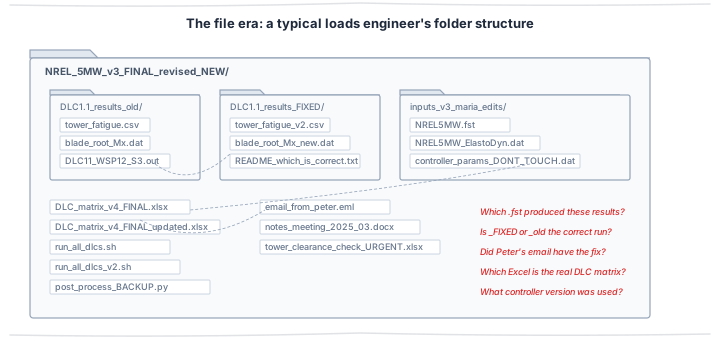
Picture this: you're running a concept design or a site-assessment. You need to set up 300+ Design Load Cases across DLC 1.2 through DLC 6.4 per IEC 61400-1. Each DLC requires specific wind conditions, turbulence seeds, yaw misalignments, and fault scenarios. The inputs live in a maze of .dat files, .csv or .xlsx tables, and custom scripts that someone wrote three years ago.
You copy a folder from the last project. You rename things. You update the tower file, tweak the blade pitch schedule, adjust the wind speeds. Then you run into a file called tower_v3_final_FINAL_mod2.dat and wonder which version was actually used in the last certification.
Sound familiar?
The solver takes 45 minutes per simulation. But the setup — wrangling files, generating input matrices, checking consistency — takes days. And when you need to trace back from a suspicious fatigue result to the exact input that produced it? Good luck.
Standards Demand Traceability. Our Tools Don't Provide It.
IEC 61400-1 and the DNV-ST-0437 standard both require that load calculations be reproducible and traceable. A certification body should be able to take your inputs, run your process, and arrive at the same results. That's the theory.
In practice, the "process" lives in a combination of shell scripts, Excel macros, a colleague's Python notebook, and tribal knowledge about which flags to set in which config file. The traceability is a post-hoc reconstruction.
This isn't a criticism of engineers. It's a criticism of the tooling. The simulation software vendors have optimized for solver speed and accuracy — rightfully so. But everything upstream (input preparation) and downstream (post-processing, reporting, traceability) is left as an exercise for the user.
The MLOps Parallel
Machine learning faced the same problem a few years ago. Data scientists had excellent models but no systematic way to track experiments, compare runs, or reproduce results. Then tools like MLflow and Weights & Biases appeared, and suddenly experiment tracking became a solved problem.
Loads engineering is overdue for the same shift. Not because we need fancier solvers, but because we need infrastructure that treats the entire workflow — from input generation to result analysis — as a first-class, version-controlled, reproducible pipeline.
What "Workflow-Native" Looks Like for Loads
Imagine a workflow where:
- Every input file is version-controlled. You can see exactly which tower file, blade definition, DLC file, and control parameters were used in any past run — not because someone documented it, but because the system tracks it automatically.
- Results link back to inputs implicitly. Every output time series knows which commit of which input files produced it. Traceability isn't a report you write — it's a byproduct of how you work.
- Post-processing is interactive. Browse time-series results in the browser. Spot a suspicious tower base moment? Click through to the exact DLC, wind conditions, and input files that produced it.
- An AI assistant helps with the tedious parts. "Reduce tower wall thickness by 5% and rerun the fatigue set" — the AI updates the file, commits the change, and triggers the workflow. And much more coming...
This isn't a fantasy. This is what Pencilroads is building.
The Cost of Staying in the File Era
Every loads engineer knows the hidden costs: the week spent debugging why results don't match a previous run (turns out someone updated the controller gains but forgot to rename the file). The junior engineer who can't reproduce the senior's setup because half the process lives in undocumented scripts. The certification delay because the auditor asked for traceability and you need three days to reconstruct the input chain.
These aren't edge cases. This is Tuesday.
The wind industry is scaling fast — larger rotors, taller towers, offshore foundations, hybrid plants. The number of load cases per project is growing. The complexity of multi-physics coupling is increasing. And we're still managing it all with folders and file names.
What Comes Next
The shift from file-based to workflow-native simulation isn't about replacing your solver. OpenFAST, QBlade, your in-house tools — they all keep working. The change is in the infrastructure around them: how inputs are managed, how runs are orchestrated, how results are stored and queried, and how teams collaborate on the process.
At Pencilroads, we're building this infrastructure. You bring your tools as actions, connect them in a workflow, and anyone on your team can run it in the cloud. The deterministic pipeline stays deterministic. The AI helps before and after — preparing inputs and analyzing results — but never touches the simulation itself.
Because at the end of the day, loads engineering isn't stuck because of bad solvers. It's stuck because the infrastructure around those solvers hasn't evolved. It's time it did.